
Taoism (Daoism)
An ancient Chinese tradition that is both a philosophy and a religion. It is about living in harmony with the Tao, "the Way" underlying the universe, and encourages simplicity, naturalness and balance between yin and yang.
📬 Want updates on Taoism (Daoism)? Subscribe to the newsletter
Overview
The Tao is the indescribable principle from which everything comes and to which everything returns. The core values:
- Wu wei, "effortless action": natural action that does not force itself on the world.
- Simplicity.
- Humility.
- Connection to nature.
Alongside the philosophy a religion developed that includes:
- Temples and worship: priests, rituals and worship of gods and immortals.
- Physical practices: tai chi and qigong, and inner alchemy.
- Traditional Chinese medicine.
Origins and History
The Tao Te Ching is attributed to Laozi and, according to tradition, was written in the 6th century BCE. Many scholars think it was compiled later and by several authors. In the 2nd century CE Zhang Daoling founded the "Way of the Celestial Masters", the first organised Taoist religion. At various times Taoism enjoyed imperial patronage and competed with Buddhism for influence at court.
Development and Branches
- Fusion and mutual influence: Taoism blended to a large extent with Buddhism and Confucianism. Together they form China's "Three Teachings".
- Quanzhen: the monastery-based Quanzhen school was founded in the 12th century.
- The Cultural Revolution: many temples were destroyed during the Cultural Revolution (1966–1976).
- Revival: since the 1980s there has been a partial revival, under state supervision.
How It Spread and Grew
🗺️ Maps of how the five largest religions spread →
Taoism spread mainly within the Chinese world: China, Taiwan, Hong Kong and the Chinese diaspora. It also influenced Korea, Japan and Vietnam. It never actively sought converts. Its influence travelled through folk religion, medicine, martial arts and culture. In the West its ideas are very popular, but usually as philosophy rather than religion.
Influence on the World
- Inspiration and culture: it influenced Chinese poetry, landscape painting and calligraphy.
- Science and medicine: it influenced Chinese medicine and early Chinese chemistry. According to the standard history, Taoist alchemists discovered gunpowder.
- Worldwide: tai chi, feng shui and the yin-yang symbol are known all over the world today.
What Draws Believers (Strengths)
- A calm, non-dogmatic approach that encourages balance and harmony with nature.
- Practices for health of body and mind.
- Deep and witty philosophical literature.
- Tolerance: it can be combined with other traditions.
Criticism and Challenges
- Gap between philosophy and practice: critics point to the gap between the lofty philosophy and folk practices seen as superstition, such as charms and magic.
- Health: the search for immortality once led to emperors being poisoned by mercury-laced "elixirs of life".
- State control: in China today the religion is under close state supervision.
Human Life, War and Peace – What It Teaches
- "Weapons are instruments of ill omen... the sage uses them only when there is no choice" (Tao Te Ching, chapter 31).
- Victory in war should be marked with mourning rites, not celebration.
- The value of life, harmony with nature, and the pursuit of longevity.
- Humility and softness are preferred to force: water is soft, yet it overcomes the hard.
- Compared with other religions: Sanctity of Life Across Religions
Religion, Power and Violence
Religiously inspired rebellions: Taoism itself encourages humility and tends to be wary of war. The Tao Te Ching calls weapons "instruments of ill omen". Even so, there were religiously inspired rebellions:
- The Yellow Turban Rebellion (184 CE), led by a Taoist messianic movement, contributed to the fall of the Han dynasty.
- Secret societies with folk-religious elements took part in rebellions later in Chinese history, including the Boxer Rebellion (1899–1901).
When believers were victims:
- At the Mongol court: in 1258 Kublai (later Great Khan) convened a debate between Taoists and Buddhists. The Taoists were declared the losers, 237 Taoist temples were handed over to Buddhists and Taoist texts were destroyed. The dispute had arisen partly because Taoists had earlier taken over Buddhist temples.
- The Cultural Revolution (1966–1976): many Taoist priests were forced to leave the priesthood and sent to labour camps, and many temples were destroyed or turned to secular use.
The other side: overall, Taoism has no history of conquest or of forcing its religion on others.
Frequently asked questions
What is Taoism – a religion or a philosophy?
Both. Chinese has two terms: daojia (道家, "the school of the Dao"), the philosophical tradition of the Tao Te Ching and the Zhuangzi, and daojiao (道教, "the teaching of the Dao"), the organised religion with temples, priests, rituals and gods. In the West the philosophical side is better known; in the Chinese world the two are intertwined.
What is the Tao Te Ching?
The central book of Taoism. Its title means roughly "The Classic of the Way and Virtue": "Tao" is the way, "Te" is virtue or power, and "Ching" is a classic. It has 81 short chapters, about 5,000 Chinese characters in all. According to one tradition, Laozi wrote it at the request of the keeper of a border pass as he was leaving for the west. The oldest manuscripts found, the Guodian bamboo slips, date from around 300 BCE.
Who was Laozi?
"Laozi" is not a personal name but an honorific meaning "the Old Master". According to tradition his name was Li Er, and he was an older contemporary of Confucius in the 6th century BCE. Scholars are divided over whether he was a historical figure, and some see him as largely legendary. In religious Taoism he became a deity: he is identified with the "Supreme Old Lord", one of the Three Pure Ones, the highest gods of Taoism.
What are yin and yang?
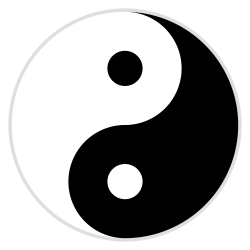
Two opposite forces that complement and depend on each other: yin is associated with darkness, receptivity and the feminine, yang with light, activity and the masculine. The familiar symbol, a circle divided into black and white, is called the taijitu. The idea is not exclusively Taoist: it is shared across Chinese thought and also appears in the Book of Changes (I Ching), in Chinese medicine and in Confucian thought.
What is wu wei?
Literally "non-doing" or "non-action". It does not mean idleness, but natural action that does not force itself on the world. In Taoism this is how the Tao itself acts: quietly, invisibly and almost effortlessly. The term also appears in the Analects of Confucius. For the differences between the two traditions, see the Confucianism page.
Compare Taoism (Daoism) with…
⚖️ Religion, war and peace – across all religions · 🕰️ Timeline