
Religion, War and Peace – Past and Present
Do religions cause wars? What research says, the great religious wars in history, today's conflicts with a religious dimension, what each religion teaches about the sanctity of life, and religion as a force for peace.
In Brief
Throughout history religions have inspired mercy, charity and peace, and have also been used to justify war, conquest and cruelty. Most scholars agree that religion is almost never the only cause of war: it is intertwined with political, national, ethnic and economic factors. But when religion is involved, it can make a conflict harder to resolve. This page brings the picture together – without blaming any one religion and without whitewashing.
In-depth chapters: Wars and Conflicts Today · The Israeli-Palestinian conflict and religion
How Many Wars Were "Religious"?
- According to the Encyclopedia of Wars (Phillips and Axelrod, 2004), of some 1,763 recorded wars in history, about 123 (about 7%) were classified as wars in which religion was a primary cause. The figure is widely cited but also contested, since the definition of a "religious war" is disputed.
- Religion as an intensifier: the researcher Monica Duffy Toft found that civil wars in which religion is a central issue tend to be longer and deadlier.
- "Cosmic war": Mark Juergensmeyer (Terror in the Mind of God) describes how framing a conflict as a "cosmic war" between good and evil makes compromise harder.
- Critics of the concept: William Cavanaugh (The Myth of Religious Violence) and Karen Armstrong (Fields of Blood) argue that the idea of "religious violence" is overstated, and that the main driver of war through history has been the state and its power.
Major Wars and Conflicts with a Religious Dimension in History
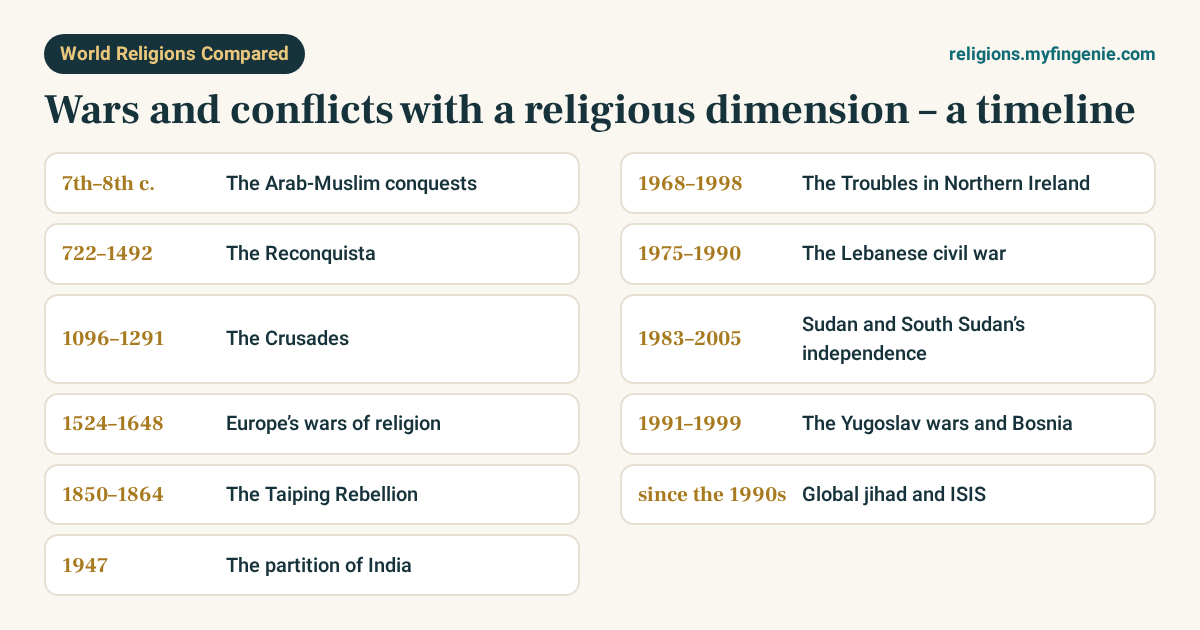
The Arab-Muslim conquests (7th–8th centuries)
- Background: after Muhammad's death (632) the caliphate expanded rapidly at the expense of the Byzantine and Sasanian empires, from Spain to Central Asia.
- Religious dimension: the conquest was carried out in the name of Islam, but conversion was usually not forced: Jews and Christians (and later Zoroastrians) received "dhimmi" status – protection and religious autonomy in return for a poll tax and restrictions. Most of the population converted to Islam over several centuries.
- Legacy: it shaped the religious map of the Middle East and North Africa to this day.
The Crusades (1096–1291)
- Background: Pope Urban II called in 1095 for the liberation of Jerusalem. The crusaders took it in 1099, Saladin retook it in 1187, and Acre, their last stronghold, fell in 1291.
- Cost: the massacre of Jerusalem's Muslim and Jewish inhabitants in 1099; massacres of Jewish communities in the Rhineland in 1096; and in the Fourth Crusade (1204) Christian Constantinople was sacked.
- Settlements: agreements were reached even in the midst of the fighting: the Treaty of Jaffa (1192) between Richard the Lionheart and Saladin allowed pilgrimage to Jerusalem, and Emperor Frederick II received Jerusalem by treaty with Sultan al-Kamil (1229) without a battle.
The Reconquista (722–1492)
- Background: the reconquest of the Iberian Peninsula by Christian kingdoms, ending with the fall of Granada in 1492.
- Cost: that same year the Jews of Spain were expelled (the Alhambra Decree); Muslims were forcibly converted, and their descendants (the "Moriscos") were expelled in 1609–1614. The Spanish Inquisition persecuted converts suspected of keeping their old faith.
- Legacy: alongside the wars, al-Andalus is also remembered for a cultural flowering shared by Muslims, Jews and Christians, though historians dispute how tolerant it really was.
Europe's wars of religion (1524–1648)
- Background: the Protestant Reformation split Western Europe. The wars included the French Wars of Religion (1562–1598, including the St Bartholomew's Day massacre of 1572) and the Thirty Years' War (1618–1648).
- Cost: an estimated 4.5 to 8 million people died in the Thirty Years' War; parts of Germany lost a large share of their population.
- How they ended: the Peace of Augsburg (1555) established that "the ruler's religion is the subjects' religion"; the Edict of Nantes (1598) granted toleration to the Huguenots in France (revoked in 1685); the Peace of Westphalia (1648) set religious and political arrangements and is often seen as a milestone in the development of the sovereign state. One lesson: mutual exhaustion, and separating questions of faith from questions of government.
The Taiping Rebellion in China (1850–1864)
- Background: Hong Xiuquan, who claimed to be the younger brother of Jesus, founded a "Heavenly Kingdom" that conquered large parts of southern China.
- Cost: estimates of 20 to 30 million dead, most from famine and disease – one of the most destructive wars in history.
- How it ended: military suppression by the Qing dynasty and regional armies.
The Partition of India (1947)
- Background: with the end of British rule, India was partitioned into India and Pakistan by religious majority (Hindu or Muslim).
- Cost: mass violence between Hindus, Muslims and Sikhs; estimates from several hundred thousand to about 2 million dead, and about 15 million displaced.
- Legacy: the Kashmir dispute and India–Pakistan hostility continue to this day. In 1971 Bangladesh broke away from Pakistan, showing that a shared religious identity alone did not hold the state together.
Sudan's civil war and South Sudan's independence (1983–2005)
- Background: the largely Muslim, Arabic-speaking north tried to impose sharia on the whole country; the south, whose people are largely Christian or followers of traditional religions, rebelled.
- Cost: an estimated 2 million dead, most from famine and disease.
- How it ended: the Comprehensive Peace Agreement (2005) included autonomy for the south and a referendum, which led to South Sudan's independence (2011). But in 2013 a civil war broke out within South Sudan itself, on ethnic and political lines.
The Troubles in Northern Ireland (1968–1998)
- Background: a national conflict between republicans, mostly Catholic, and unionists, mostly Protestant, over whether the province would stay in the United Kingdom.
- Cost: about 3,500 dead.
- How it ended: the Good Friday Agreement (1998): power-sharing between the communities, recognition of the residents' right to decide the province's future by majority, decommissioning of weapons and release of prisoners. Clergy from both sides were involved in secret channels of dialogue. The peace holds, but society is still largely segregated (neighbourhoods, schools, "peace walls").
The Lebanese civil war (1975–1990)
- Background: a sectarian system of government, an armed Palestinian presence, and Syrian and Israeli involvement. The fighting was between Christian, Sunni, Shia and Druze militias.
- Cost: about 120 to 150 thousand dead; massacres by several sides.
- How it ended: the Taif Agreement (1989) rebalanced power-sharing between the communities. Critics argue that it entrenched the sectarian system and the power of former militias, and Hezbollah remained armed.
The Yugoslav and Bosnian wars (1991–1999)
- Background: as Yugoslavia broke up, religious-national identities clashed: Orthodox Serbs, Catholic Croats and Muslim Bosniaks, and later also in Kosovo.
- Cost: about 100 thousand dead in Bosnia alone; the Srebrenica genocide (1995) – about 8,000 Muslim men and boys. Mosques and churches were deliberately destroyed.
- How it ended: the Dayton Agreement (1995) ended the war in Bosnia with power-sharing between the three groups. Critics argue that the structure entrenches ethnic-religious division and paralyses the state.
Global jihadism and ISIS (since the 1990s)
- Background: al-Qaeda (the 9/11 attacks of 2001) and later ISIS, which declared a "caliphate" in Iraq and Syria in 2014.
- Cost: genocide against the Yazidis (from August 2014), the enslavement of thousands of women, mass executions of Shia, Christians and Sunnis who resisted. Most victims of jihadism worldwide are Muslims.
- How it ended (partly): the territorial caliphate was defeated by 2019 by an international coalition and local forces, but the organisation and its branches remain active, mainly in Africa and Afghanistan.
What Helped End Conflicts with a Religious Dimension
- Separating religion from the practical dispute: neither the Peace of Westphalia nor the Good Friday Agreement decided who was right on questions of faith; they settled government, borders and rights.
- Power-sharing and guarantees for minorities: Taif, Dayton and Northern Ireland. The drawback: dividing power by community can freeze identities and paralyse government.
- Autonomy or separation: Bangsamoro in the Philippines, and South Sudan (which also showed that separation does not guarantee calm).
- Arrangements around holy places: the Ottoman "Status Quo" (from 1757 and 1852) in the Church of the Holy Sepulchre and other holy places still governs control among the Christian denominations.
- Clergy as mediators: the Community of Sant'Egidio in Mozambique (1992), religious leadership in Liberia and South Africa, and the pastor and imam of Kaduna. Religious leaders have a legitimacy politicians lack – but also the ability to sabotage it.
- Truth, justice and reconciliation: truth commissions (South Africa) and tribunals (for the former Yugoslavia and Rwanda) – so that victims are recognised and violence does not return.
- What researchers warn: agreements that leave out the armed groups or the religious public can unravel; and a formal peace without change in education and the economy sometimes remains a "cold peace".
Current Conflicts with a Significant Religious Dimension
For each conflict in detail – background, what makes peace hard and what might help: Wars and Conflicts Today.
The situation changes, and religion is usually one of several factors, alongside national, ethnic and economic ones:
- The Israeli–Palestinian conflict: a national conflict with prominent religious elements, such as the Temple Mount/al-Aqsa, and extremist religious currents on both sides. The full chapter: The Israeli-Palestinian Conflict and Religion.
- Kashmir: between India and Pakistan, and Hindu–Muslim tensions. In April 2025 an attack near Pahalgam killed 26 people, most of them Hindu tourists, and in May 2025 a brief military clash broke out between the two countries.
- Syria: after the fall of the Assad regime (December 2024) – sectarian violence against Alawites on the coast (March 2025; a government fact-finding committee counted 1,426 dead) and against Druze in Suwayda (July 2025; according to human rights groups, more than a thousand dead).
- The Sahel and Nigeria: jihadist insurgencies by Boko Haram and groups linked to al-Qaeda and ISIS, and also Christian–Muslim tensions.
- Myanmar: the persecution of the Rohingya Muslims and the refugee crisis since 2017.
- Afghanistan and Pakistan: Taliban rule and sectarian attacks on Shia and minorities.
- Yemen and the Gulf: a regional struggle with a Sunni–Shia dimension.
Sanctity of Life Across Religions
Every major religion forbids murder and treats human life as sacred. The differences lie in three questions: where the value comes from, whom it covers (humans only, or every living being), and when taking life is still allowed – self-defence, war, the death penalty and martyrdom.
| Religion | Principle and source | Whom it covers | When taking life is allowed | Dying for the faith |
|---|---|---|---|---|
| Judaism | "Whoever saves a single life... it is as if he saved an entire world" (Mishnah, Sanhedrin). Pikuach nefesh – saving a life – overrides almost every commandment. | Humans, created in God's image; also a ban on cruelty to animals | Self-defence ("if someone comes to kill you, kill him first"), a commanded war. The Torah's death penalty, which the rabbis restricted almost to abolition | Kiddush Hashem – only when the choice is murder, idolatry or forbidden relations ("be killed rather than transgress"). Suicide is forbidden |
| Christianity | Humans are created in God's image. "You shall not murder" and "love your enemies". | Humans | Self-defence and "just war" (Augustine, Thomas Aquinas). In 2018 the Catholic Church declared the death penalty "inadmissible" | Martyr – one killed for the faith, not one who kills. Suicide is considered a sin |
| Islam | "Whoever kills a soul... it is as if he had slain all mankind" (Quran 5:32). The verse opens "We decreed upon the Children of Israel" – it presents the rule as a commandment given to the Jews, and it is almost identical to the Mishnah. "Necessity permits the forbidden" – similar to pikuach nefesh. | Humans; also a duty of mercy to animals | Retaliation or blood money (qisas), hudud punishments, jihad within rules – no harm to women, children or the elderly | Shahid – one killed in the path of God (and in cases such as plague). Suicide is forbidden; most scholars forbid suicide attacks, and a minority has permitted them |
| Hinduism | Ahimsa – non-harm. The soul (atman) is present in every being. | All living beings | The warrior's duty to fight a just war (Bhagavad Gita) | No central equivalent |
| Buddhism | The first precept: refrain from taking life. Compassion for all beings. | All living beings | No "just war" doctrine. Killing harms the killer's karma | None |
| Jainism | Absolute ahimsa – even towards insects. Monks sweep the path before every step. | All living beings, even the smallest | Almost never | Sallekhana – a believer's fast to death at the end of life, under defined conditions |
| Sikhism | God's light is in every person, and all people are equal. | Humans | Protecting the weak and persecuted, as a last resort: "when all other means have failed, it is right to draw the sword" (Guru Gobind Singh) | The ideal of the "saint-soldier" |
| Bahá'í Faith | The unity of humanity and world peace. | Humans | Death or life imprisonment for murder appears in the book of laws (Kitáb-i-Aqdas) | None |
| Druze | Protecting one's brethren in faith, and belief in immediate reincarnation. | Humans | Defending the community and loyalty to the state they live in | No central concept |
| Taoism | Valuing life and bodily health. Weapons are "instruments of ill omen" (Tao Te Ching, 31). | Humans and nature | War only when there is no choice, and with sorrow | None |
| Confucianism | Ren – humaneness. The body is received from one's parents and must not be harmed. | Humans | The death penalty exists in the tradition. Government should rest on moral example, not force | None |
| Zoroastrianism | Life is part of Ahura Mazda's good creation, against the forces of destruction. | Humans and "good" creatures | Fighting the forces of evil | None |
| Shinto | Life and nature are sacred, through the kami. | Humans and nature | No systematic teaching on taking life | No central religious concept |
| Chinese folk religion and African traditional religions | Life force and the bond with ancestors and community. | Humans and the community | Varies greatly between traditions | Varies |
What the comparison shows
- No religion can be said to "value life more" – the core principle is similar, sometimes almost word for word: the Quran's verse on "whoever saves a soul" comes from Judaism – it presents itself as a commandment to the "Children of Israel" and matches the Mishnah (Sanhedrin 4:5).
- The most explicit legal formulation of the supremacy of human life is pikuach nefesh in Judaism. The broadest scope – every living being – is in Jainism and Buddhism.
- The big differences are in the exceptions – war, the death penalty and martyrdom – and above all in how movements within each religion interpret them. The same source serves both calls for peace and justifications of violence.
Suicide Attacks and Religion
What the religions say
- Judaism, Christianity and Islam forbid suicide. In Islam an explicit hadith says that whoever kills himself is punished in hell.
- Martyrdom – kiddush Hashem, the Christian martyr, the shahid – is in every religion one who is killed for his faith, not one who kills himself in order to kill others.
- Jainism has a voluntary death (sallekhana), but it is a fast at the end of life that harms no one.
How the ban is bypassed
Islamist organisations distinguish between "intihar" – suicide, which is forbidden – and "istishhad" – seeking martyrdom, which is holy. The same act is thus presented as a commandment, with a promise of paradise and honour for the family.
- Permitted it: clerics such as Yusuf al-Qaradawi, mainly against Israelis.
- Forbade it: many senior clerics, among them Saudi Arabia's Grand Mufti and Tahir-ul-Qadri's fatwa (2010) against terrorism and suicide bombings.
History – not only religion
- Ancient stories: Samson ("let me die with the Philistines"), the Sicarii of the Second Temple period and the Assassins (11th–13th centuries) went on missions with no return – but without blowing themselves up.
- The Japanese kamikaze (1944–1945): mainly nationalism and the cult of the emperor, with an element of State Shinto.
- The modern wave began in 1983 in Lebanon, with the bombing of the US Marines barracks in Beirut by a Shia group identified with Hezbollah. From there it spread to Hamas and Palestinian Islamic Jihad (from the 1990s) – and to secular groups too: the Tamil Tigers in Sri Lanka and Fatah's al-Aqsa Martyrs' Brigades.
- Since 2003 – in Iraq, Afghanistan, Syria and Africa – most suicide attacks in the world have been carried out by Salafi-jihadist groups such as al-Qaeda and ISIS.
What research says
- Robert Pape ("Dying to Win", 2005): the main motive is strategic – a weak organisation against a strong state seen as an occupier, with a cheap and precise weapon.
- Assaf Moghadam ("The Globalization of Martyrdom", 2008): Salafi jihadism turned the method from a tool of local national struggle into a global one – and here religion plays a more central role.
- Researchers describe religion mainly as a force multiplier: it gives legitimacy, helps recruitment and strengthens commitment to the group (recorded wills, public glorification).
Bottom line
Religion is not necessary for suicide attacks – there are secular cases – and not sufficient – most believers and clerics reject them. But in the last generation it has been their most common justification, mainly in one current: Salafi jihadism.
Religion as a Force for Peace
- Mozambique (1992): the Catholic Community of Sant'Egidio mediated the peace agreement that ended a civil war.
- Liberia (2003): Christian and Muslim women led by Leymah Gbowee led a protest that helped end the war. Gbowee received the Nobel Peace Prize.
- South Africa: Archbishop Desmond Tutu led the Truth and Reconciliation Commission.
- Nonviolent struggles: Gandhi (inspired by ahimsa) and Martin Luther King Jr. (inspired by Christianity) led nonviolent movements that changed countries.
- Cambodia: the Buddhist monk Maha Ghosananda led peace marches after the Khmer Rouge regime.
- "Document on Human Fraternity" (2019): signed in Abu Dhabi by Pope Francis and the Grand Imam of al-Azhar, Ahmed el-Tayeb.
The Israeli-Palestinian Conflict and Religion
An in-depth chapter on the conflict where religion and nationhood are intertwined.
Further Reading
- Pew Research Center – Religious restrictions and hostilities
- Wikipedia – Religious war
- Wikipedia – 2025 massacres of Syrian Alawites
- Wikipedia – 2025 Pahalgam attack
- Wikipedia – Peace of Westphalia
- Wikipedia – Good Friday Agreement
- Wikipedia – Status Quo (Jerusalem and Bethlehem)
- Uppsala Conflict Data Program – global conflict data